For art-agenda I wrote a review of Jeannette Ehlers’s “Archives in the Tongue: A Litany of Freedoms” at Kunsthal Charlottenborg. For years Ehlers has been one of the most prominent artists confronting a Danish public to its colonial past and present, not least thanks to the much-debated monument, the seven-meter tall sculpture I am Queen Mary, which Ehlers created in collaboration with La Vaughn Belle. Erected on the occasion of the 100th anniversary of the sale and transfer of the U.S. Virgin Island (the former so-called Danish West Indies), the monument intervened in the white, patriarchal city landscapes of Denmark (of which 98 % of its monuments, as Ehlers is fond of saying, consist of white men). Despite having undergone severe damage during a storm, I am Queen Mary is still standing in front of a former colonial warehouse at the Copenhagen harbor, now awaiting its perpetuation through and with the material Stofflichkeit of bronze. In the excessively white and increasingly racist contexts of the Nordic welfare states, Ehlers’s strategies for Black empowerment are rare, and her exploration of (counter-)monumentality, anger, and the limits of legitimate violence seems therefore both timely and productive. This was also the case in the performance work Whip it good! (2014) in which Ehlers whipped a white surface with remnants of coal, a multilayered (re)enactment punishing Western art history’s patriarchal and white supremacy point of view, while also making visible the wounds of black lives in antagonistic and traumatic “painterly” gestures which the audience was invited to participate in. With the new exhibition, Ehlers both builds further on these strategies while also pursuing a slightly new direction. Occupying a key site of the former architectural pride and wealth of colonial violence and exploitation, Ehlers has turned the building at Charlottenborg into a scene for healing, care, and collective entanglement of the Black diaspora.
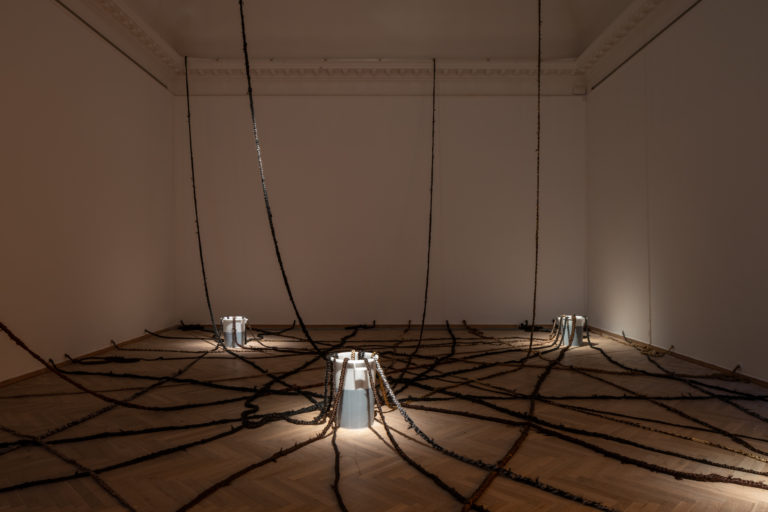
Here’s an excerpt of the review: “More subtle but equally stunning is We’re Magic. We’re Real #3 (Channeling Re-existence into Hollowed Grounds of Healing) (2022), which comprises huge, collectively made braids appearing to grow out of the white walls and ceiling. These braids trail the floor—viewers have to walk carefully to avoid stepping on them—and gather in white plastic tubs filled with dark, bubbling water: resting places of trauma and collective labor, but also enigmas of healing and revolt. This tension between rest and unrest is epitomized in a woman’s whispering voice in the last room of the exhibition. The installation Coil: The Sensuous Way of Knowing (2022) takes the form of an altar, consisting of a portrait-format video flanked by two rows of glowing iPhones, raised on selfie sticks, whose screens show YouTube footage of various historical Black uprisings. These lead up to the larger screen, which shows intimate and undramatic footage of hair being braided: “In these hands are a language unspoken / tightly bound in rebellious manes / Spirits secrets slept in every braid woven / heard gently over the clankering chains.” If history is indeed made in uprisings of the oppressed, Ehlers tells us, it is the everyday practices of braiding, weaving, and entangling that prepare the ground.”
Read the whole review here.
Image credit: Jeannette Ehlers, We’re Magic. We’re Real #3 (Channeling Re-existence into Hollowed Grounds of Healing), 2022. Synthetic hair, buckets, pumps, water, dimensions variable. Image courtesy of the artist. Installation view, Archives in the Tongue: A Litany of Freedoms, Kunsthal Charlottenborg, 2022. Photo by David Stjernholm
 Tobias Dias